
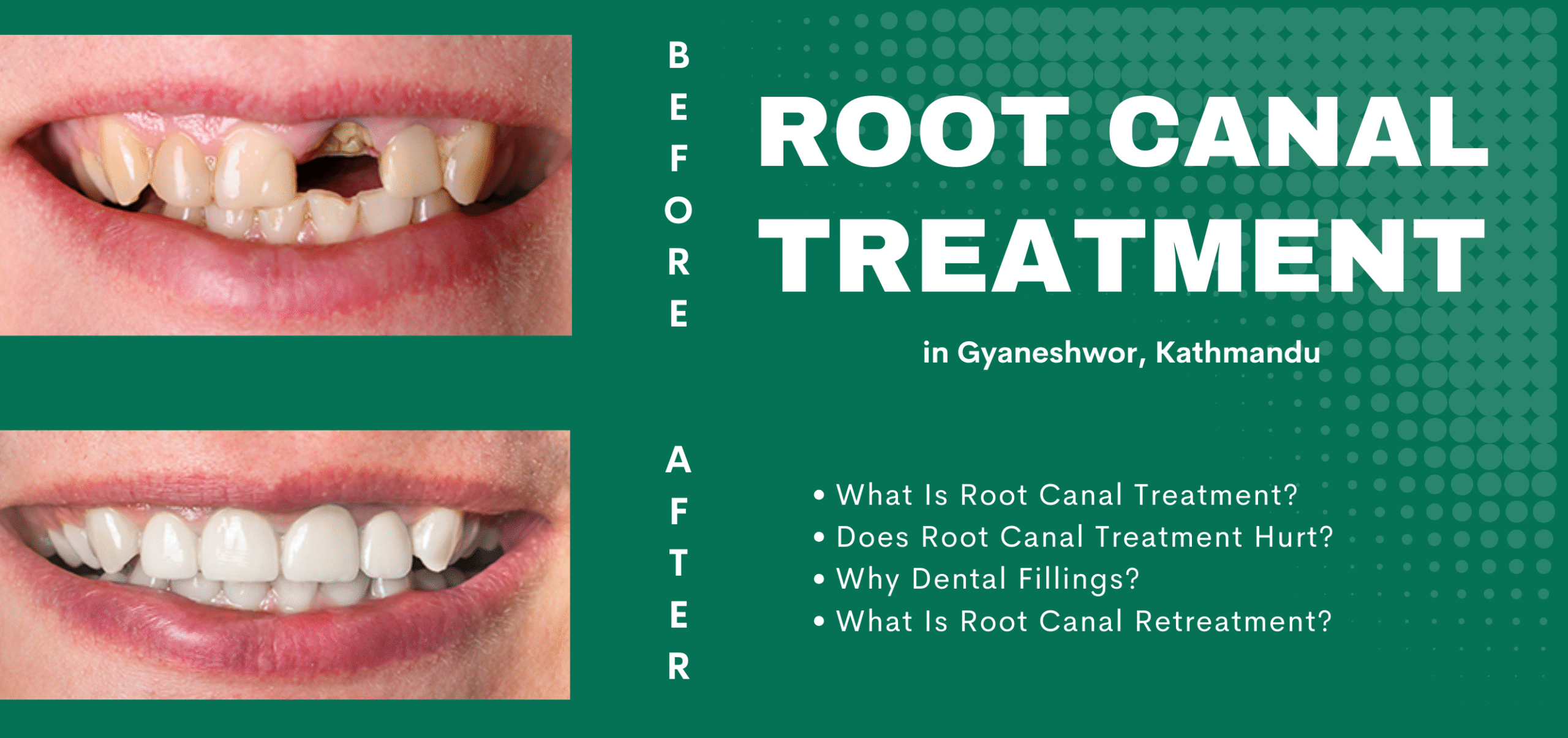
Need root canal treatment in Gyaneshwor, Kathmandu? D-Smile Dental Clinic offers expert root canal therapy performed by experienced endodontists. Our modern techniques and equipment make root canal treatment comfortable and effective, saving your natural tooth and relieving your pain.
Root canal treatment has an undeserved reputation for being painful. In reality, modern root canal therapy is no more uncomfortable than getting a filling, and it eliminates the severe pain caused by infected tooth pulp. At D-Smile Dental, we specialize in painless root canal treatment that preserves your natural tooth for years to come.
What Is Root Canal Treatment?
Root canal treatment (RCT), also called endodontic therapy, is a procedure to save a tooth whose inner pulp (nerve and blood supply) has become infected or damaged. The treatment involves:
- Removing the infected or damaged pulp tissue
- Cleaning and shaping the root canals
- Filling the canals with biocompatible material
- Sealing the tooth to prevent reinfection
- Restoring the tooth with a crown (usually recommended)
The goal is to eliminate infection, relieve pain, and save your natural tooth rather than extracting it.
When Is Root Canal Treatment Needed?
Root canal treatment is necessary when the pulp inside your tooth becomes infected or inflamed. Common causes include:
- Deep decay: Cavities that reach the pulp chamber
- Repeated dental procedures: Multiple treatments on the same tooth
- Cracked or chipped tooth: Allowing bacteria to enter
- Trauma: Injury to the tooth, even without visible damage
- Large fillings: That compromise the pulp
- Gum disease: Severe periodontal infection
Signs You May Need a Root Canal
Watch for these warning signs that indicate possible pulp infection:
- Severe toothache: Especially when chewing or applying pressure
- Prolonged sensitivity: To hot or cold that lingers after the stimulus is removed
- Darkening of the tooth: Discoloration indicating pulp death
- Swelling: In the gums near the affected tooth
- Pimple on gums: A recurring bump (fistula) that may drain pus
- Tender gums: Around a specific tooth
- Bad taste: Persistent unpleasant taste in the mouth
⚠️ Don't Ignore Tooth Pain!
If you're experiencing any of these symptoms, don't wait. Delaying treatment can lead to abscess formation, bone loss, and eventually tooth loss. Early treatment is simpler, more successful, and less expensive.
The Root Canal Procedure at D-Smile Dental
Step 1: Diagnosis
Our endodontist examines your tooth and takes X-rays using our portable X-ray gun. We assess the extent of infection and plan the treatment.
Step 2: Anesthesia
Local anesthesia completely numbs the tooth and surrounding area. You won't feel pain during the procedure - just some pressure.
Step 3: Access Opening
A small opening is made in the crown of the tooth to access the pulp chamber.
Step 4: Pulp Removal
Using specialized instruments, the infected or damaged pulp tissue is carefully removed from the pulp chamber and root canals.
Step 5: Cleaning & Shaping
The canals are thoroughly cleaned, disinfected, and shaped to receive the filling material. This is the most critical step for long-term success.
Step 6: Filling
The cleaned canals are filled with gutta-percha, a biocompatible rubber-like material, and sealed with adhesive cement.
Step 7: Temporary Filling
A temporary filling closes the access opening until your permanent restoration is placed.
Step 8: Crown Placement
In most cases, a crown is recommended to protect and strengthen the treated tooth. This is done in a follow-up appointment.
💡 Single-Sitting Root Canal
For suitable cases, we offer single-sitting root canal treatment where the entire procedure is completed in one appointment. This saves time and reduces the number of visits. Ask our endodontist if you're a candidate for single-sitting RCT.
💰 Root Canal Prices at D-Smile Dental, Gyaneshwor
- RCT - Anterior (Dentist)Rs. 6,000 - 8,000
- RCT - Anterior (Specialist)Rs. 8,000 - 10,000
- RCT - Premolar (Dentist)Rs. 8,000 - 10,000
- RCT - Premolar (Specialist)Rs. 10,000 - 12,000
- RCT - Molar (Dentist)Rs. 12,000 - 15,000
- RCT - Molar (Specialist)Rs. 15,000 - 20,000
- Single Sitting RCT - AnteriorRs. 12,000
- Single Sitting RCT - PremolarRs. 15,000
- Single Sitting RCT - MolarRs. 18,000 - 22,000
*Crown cost is additional. Retreatment prices vary.
Does Root Canal Treatment Hurt?
This is the most common concern, and we're happy to reassure you:
- During the procedure: With modern anesthesia, you should feel no pain - only pressure and vibration
- After the procedure: Some tenderness is normal for a few days, manageable with over-the-counter pain relievers
- Compared to the toothache: Root canal treatment relieves the severe pain of an infected tooth
At D-Smile Dental, our endodontists are skilled in painless techniques. Many patients are surprised at how comfortable the procedure is!
Root Canal vs. Tooth Extraction
Why save a tooth with root canal when you could just extract it?
Benefits of Saving Your Natural Tooth:
- Maintains natural appearance and function
- Preserves jawbone (extraction leads to bone loss)
- Prevents adjacent teeth from shifting
- More cost-effective than extraction + replacement
- Natural teeth feel and function better than replacements
- No need for implants, bridges, or dentures
Extraction should be a last resort when a tooth truly cannot be saved. Our endodontists will honestly advise you on the best option for your situation.
What Is Root Canal Retreatment?
Sometimes a previously treated tooth may become reinfected or fail to heal properly. Retreatment involves:
- Removing the previous filling material
- Re-cleaning and disinfecting the canals
- Identifying and treating any missed canals
- Refilling and resealing the tooth
Retreatment is more complex than initial treatment but can save a tooth that would otherwise need extraction.
After Your Root Canal Treatment
Immediate Aftercare:
- Avoid eating until numbness wears off
- Take prescribed medications as directed
- Avoid chewing on the treated tooth until crowned
- Some sensitivity is normal for a few days
Long-term Care:
- Get a crown placed promptly (usually within 2-4 weeks)
- Maintain good oral hygiene
- Attend regular dental checkups
- The treated tooth can last a lifetime with proper care
Why Is a Crown Needed After Root Canal?
After root canal treatment, the tooth becomes more brittle because:
- The blood supply is removed
- Tooth structure is lost during treatment
- The tooth is more prone to fracture
A crown protects the tooth from breaking and restores full function. Skipping the crown is a common reason for root canal failure.
Why Choose D-Smile Dental for Root Canal in Gyaneshwor?
- Experienced endodontists: Specialists in root canal treatment
- Modern equipment: Including portable X-ray for chairside diagnosis
- Painless techniques: Effective anesthesia and gentle approach
- Single-sitting option: Complete treatment in one visit when possible
- High success rate: Quality treatment for lasting results
- Complete care: From root canal to crown, all under one roof
- Affordable pricing: Quality endodontic care at fair prices
Root Canal Myths Debunked
Myth: Root canals are extremely painful
Fact: Modern root canal treatment is no more painful than getting a filling. The procedure relieves pain, not causes it.
Myth: It's better to just extract the tooth
Fact: Saving your natural tooth is almost always the better option for your oral health and wallet.
Myth: Root canals cause illness
Fact: This myth is based on debunked research from the 1920s. Root canal treatment is safe and effective.
Myth: Root canal treatment takes many visits
Fact: Most root canals are completed in 1-2 visits. We even offer single-sitting treatment for suitable cases.